Yusuf Parak

About

My work spans product thinking, strategy, interfaces, design, systems and code, with a focus on carrying ideas from wireframe to production.

It sounds trite but it's an endlessly fun balancing act between 1) trying to prototype tools as magical to us today as Midjourney might seem to a cave painter (sisyphean struggle as it may be), and 2) building those tools in a way that captures hearts and solves for distribution.

Previously I created Pinched.io, a search and sourcing tool built on top of Twitter’s social graph for finding uniquely talented people among combined social graphs (Pioneer S22). Worked as an early employee and front-end/design engineer at Thinkst Canary, an information security company that alerts your security team when your internal network has been breached. And studied Computer Science and Informatics in college.

Golden ratio. Euclid, c. 300 BC.

Now

Designing and building interactive projects — blending creative direction, technical development and strategy for individuals and teams.

Contact

Johannesburg, South Africa
T +27 081 039 1830
EmailGitHubAre.na

Kami

Kami is a fast, lightweight and local markdown editor built for people who value privacy and speed. It works offline, weighs under 15 MB, is open source and completely free. Folks use it as their second brain, PKMS or writing tool.

Details

Product Design & Engineering. 2026.

It's built with Tauri, Rust, React and CodeMirror; keeps documents on disk, supports multiple windows, renders extended markdown (LaTeX, Mermaid diagrams & tables), and has Andy Matuschak inspired Miller Column support.

Fast & Private. All documents live locally, open blazingly fast and keyboard shortcuts make navigating and editing quick and easy.Miller Column Support. Open documents side by side in a columnar layout, inspired by Andy Matuschak's notes.Extended Markdown. Mermaid charts, LaTeX, tables and HTML rendered beautifully while keeping the editor simple and focused.Customizable. Settings encompass most things. Since Kami is open source you can fork it and customize it to your liking.

Thinkst Canary

I worked as an early employee and design engineer at Canary, an infosec company that alerts your security team when your internal network has been breached. In my time there, Canary bootstrapped its way to $12m ARR while scaling rapidly.

Details

Product Design & Engineering. 2019–2021.

I touched almost every product surface area, including working on a port of the legacy dashboard to a newly designed UI and modern codebase. Canary, despite being an enterprise infosec product, is much loved for its design simplicity.

Simple by design. “I think they should make their dashboard more flashy because it almost makes you feel like they don’t have the capabilities that they actually do. It’s actually almost so simple that you feel like it’s kind of too simple.”

Delightful design system. Most security products feel clunky and 'enterprisey'. Canary was intentionally designed to be a delightful alternative. It’s why it’s one of the most loved infosec products.

Canarytokens.org. An open source project that helps folks find bad actors accessing stuff they shouldn’t. Drop Canarytokens in your files (or anywhere) and they act as tripwires.GitHub Stars2k

Gaussian Particle Generator

While working on a site for an architecture studio, I built a browser based particle generator that takes an image and outputs a gaussian splat using Apple's ML SHARP, Three.js & GPGPU.

Details

Creative Design & Engineering. 2026.

The technical beauty of the project lies in how it compresses the output from ML SHARP into pgs.gz format (10–13% of original size), which is then decoded and rendered in the browser using Three.js.

Try it live. Switch images/scenes. Explore them as a material system: light, depth, and texture. The site and its interactions try to turn a still architectural image into something spatial and tactile.

Pinched.io

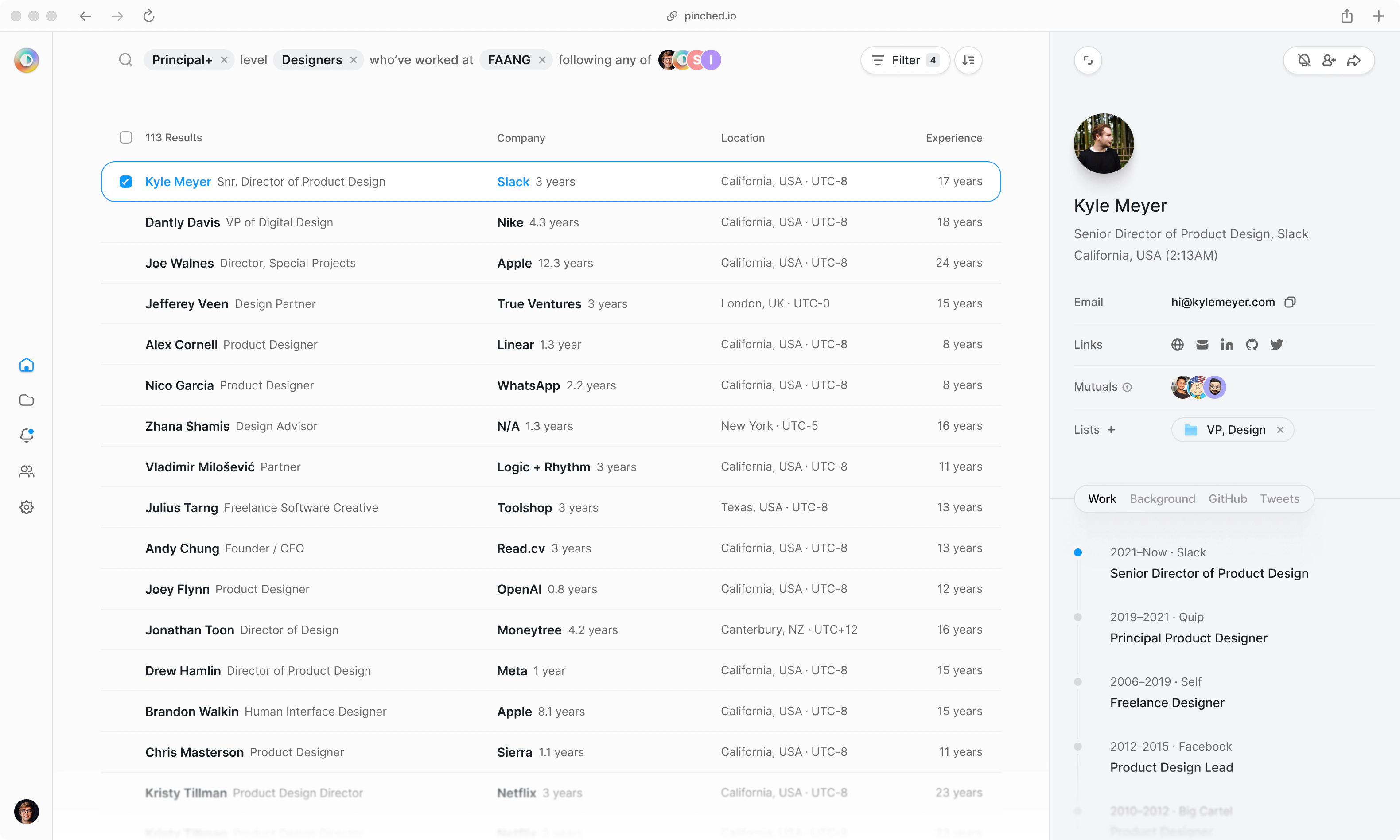
Founded a company to make finding uniquely talented people from within your network more legible. For example: “Find all designers in London who follow me or my investors and have worked at X company.”

Details

Founder, Designer & Engineer. 2021–2023.

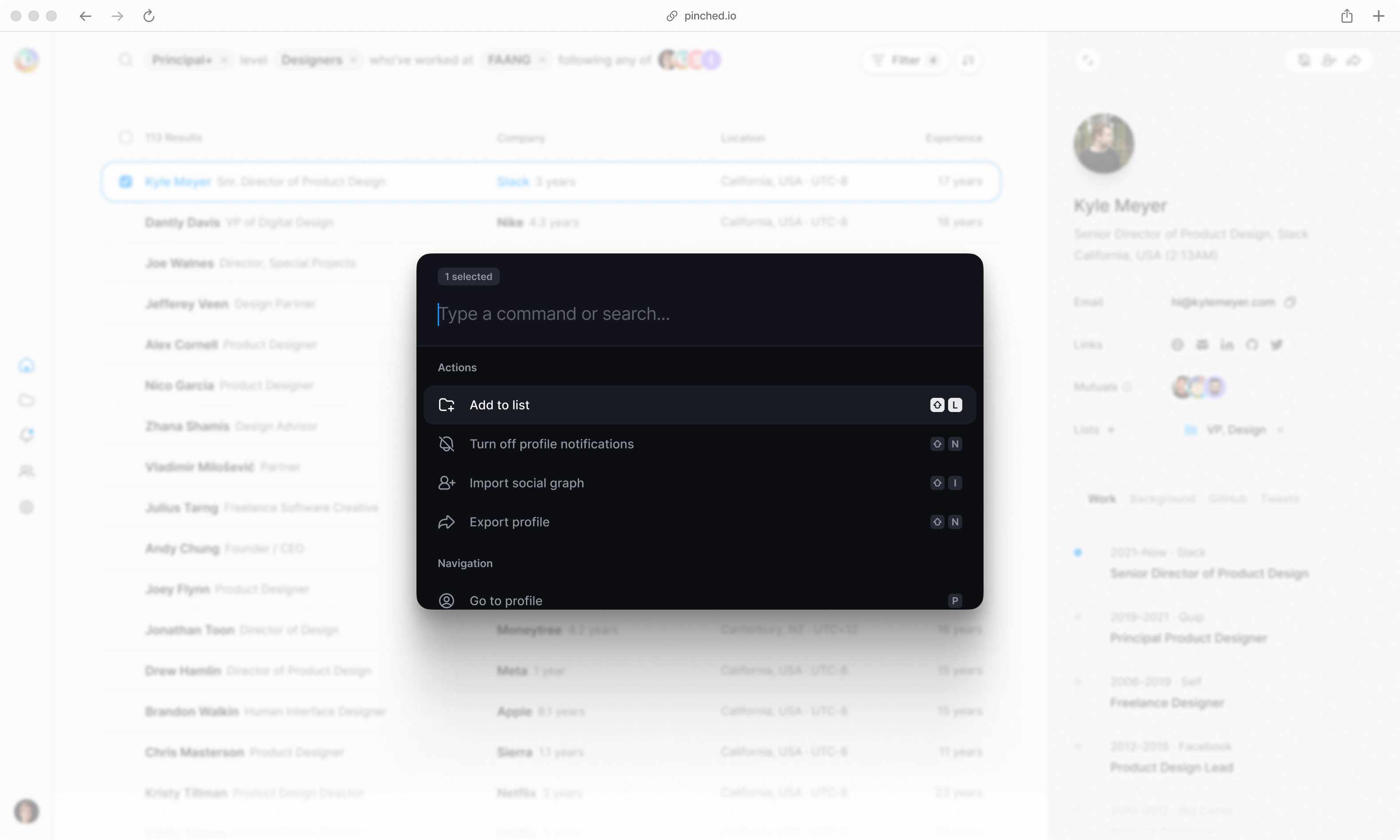
It combined pre-enriched data from Twitter, GitHub and LinkedIn with an expansive boolean search engine built on top that allowed folks to search by skills, experience and interests.

The product was built around speed, clarity and high-signal data, helping users move from a broad professional network to a relevant shortlist with minimal friction.

iPad Frame

The Pinched design system allowed me to design in code and ship fast, something I as a solo founder balancing multiple jobs to be done, desperately needed.

iPad Frame

The original Pinched landing page was designed and built in a weekend and without consciously optimising for it, had a surprisingly high conversion rate (36%) of sign-ups to users.

Lil Designer

I designed and built a suite of tools for on–the–go rapid prototyping and wireframing with the goal of minimising the feedback loop between idea and iteration.

Details

Product Design & Engineering. 2021.

These tools were built for fun after being heavily inspired by Apple's WWDC 2021, and their ability to continually push unique and intuitive interaction mechanisms.

01 Prototyper. I built a simple iPad app that let me quickly get ideas out of my head using code-first prototyping. Framer.js provided a lightweight and expressive way to add interactivity.02 Wireframer. The advantage of using an iPad over paper, aside from finer grained control, is that we can mathematically intuit what each sketch represents and flesh it out with pre-built primitives.

AI Image Gen Concept

Rethinking the image generation experience through a more visual, intuitive, and fluid approach to creative exploration. What would a tool build for power users look like? And how would that affect UI density and information hierarchy?

Details

Art Direction & Product Design. 2025.

Explored how professional-grade image generation tools could feel lightweight, spatial, and visually immersive, balancing prompt input, model selection, asset handling, and image browsing in a single creative workspace.

The interface was designed to fade into the background, acting as an enabling environment for both professional and non-professional creative work.

Spring (Primavera),
Sandro Botticelli, circa 1482
Merahi metua no Tehamana
Paul Gauguin, 1893
Self Portrait
Vincent van Gogh, 1887
Self-portrait with Thorn Necklace
Frida Kahlo, 1940

As part of the project I created a series of generative art pieces derived from historically iconic portraits. The preserved areas of the paintings act as focal points, evoking a sense of connection between the past and the future of media.

Shot Blue Marilyn
Andy Warhol, 1964
Portrait of Giovanna Tornabuoni
Domenico Ghirlandaio, 1488
Ginevra de' Benci
Leonardo da Vinci, circa 1478
Lady with an Ermine
Leonardo da Vinci, 1489–1491

As part of the project I created a series of generative art pieces derived from historically iconic portraits. The preserved areas of the paintings act as focal points, evoking a sense of connection between the past and the future of media.

Dakora

Designed a brand identity and online shopping website for Dakora, a South African homeware brand. The website brings Dakora’s furniture, accessories, café, apartments and journal into a single editorial storefront.

Details

Brand Design & Website Dev. 2026.

The work translated its quiet, enduring approach to design into a restrained visual system: measured typography, generous spacing and image-led layouts allow the materials, objects and spaces to remain the focus.

The site was designed to feel more like a quiet catalogue than a conventional online shop, giving Dakora’s products, spaces and editorial world room to speak for themselves.

Infiniteloop

Branding and visual identity for Infiniteloop a Johannesburg based music and sound production studio. Infiniteloop provides recording equipment, mixing and audio production for artists & companies.

Details

Art Direction & Brand Design. 2024.

I designed a brand and visual identity built around the constraints of being Timeless, Scalable and Industrial. This fit what Infiniteloop wanted to be known for: providing a great studio experience.

A modular design system built from the visual language of studio hardware, signal flow, and repetition. The result is a flexible brand that feels technical, durable, and approachable without relying on familiar clichés.

Yusuf Parak